
Cognitive readiness, measured

Measure your cognitive readiness.
Don't infer it.

Your Whoop can tell you your nervous system is stressed. It can't tell you your reaction time is 80ms slower than yesterday. BASLN measures your brain directly with six research-validated cognitive tests. Five minutes. Every morning.

Free for first 10 sessions · End-to-end encrypted in iCloud

BASLN - Cognitive readiness. Measured, not estimated. 5 min a day. | Product Hunt
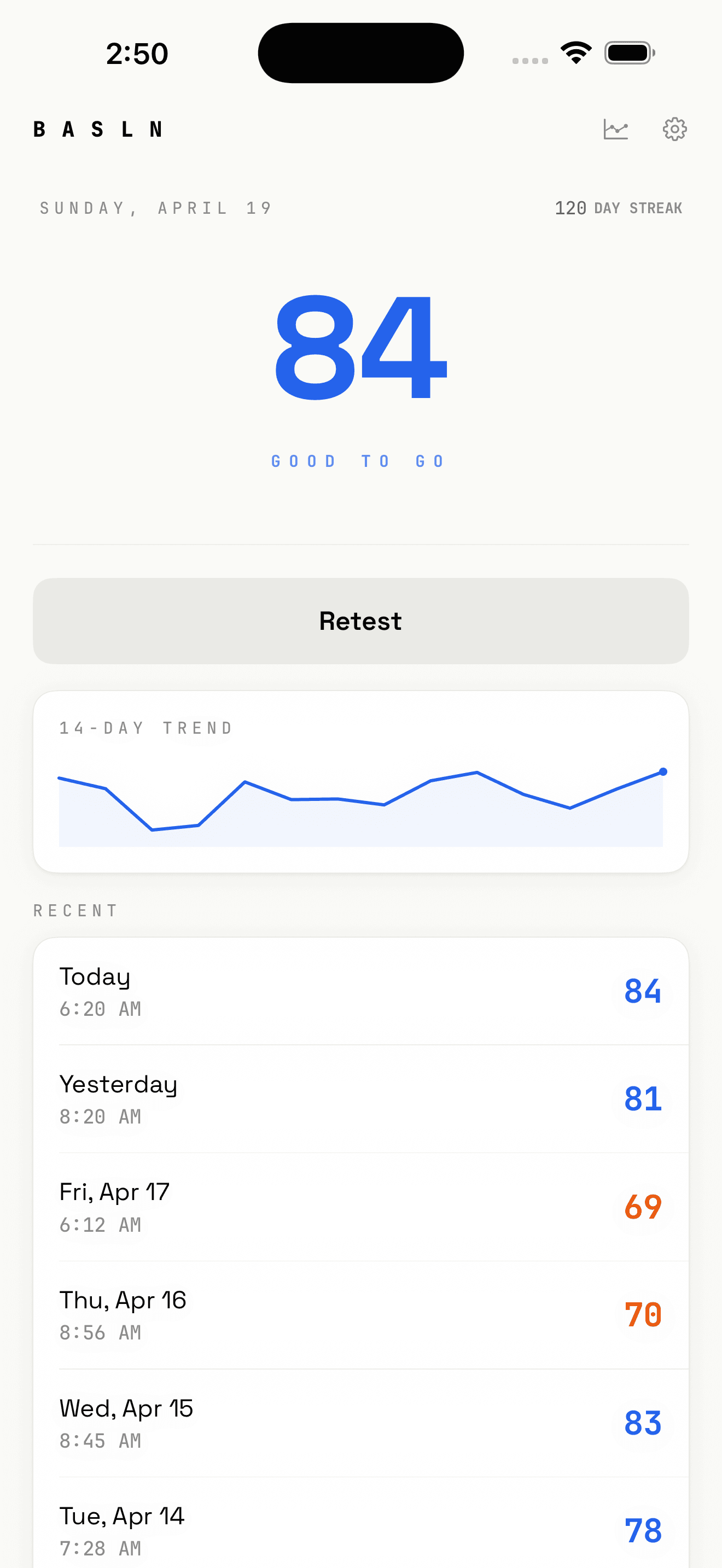
BASLN home screen showing today's cognitive readiness score of 84 (Good to Go) with a 14-day trend and recent session history
BASLN for iPhone · Actual screen
Measure vs. infer

Wearables guess about your brain.
BASLN measures it.

HRV, sleep stages, and respiratory rate tell you about your autonomic state. They don't tell you how fast you react, how much you remember, or how well you focus. Those require cognitive tests.

What you want to knowWearableBASLN
Fatigue SensitivityHRV proxyPVT-B (gold standard)
Working MemoryInferred from sleepSpatial 2-Back, per session
Processing SpeedNot measuredDigit Symbol Substitution
Executive FunctionNot measuredColor-Word Stroop
Cognitive ThroughputNot measuredSerial arithmetic under time pressure
Cognitive FlexibilityNot measuredTrail Making B
The battery

Six tests. Five minutes. Every morning.

Each test is a compressed version of an instrument used in peer-reviewed cognitive research. Together they cover the core dimensions of operational cognitive performance.

01 · PVT-B

Psychomotor Vigilance Test (PVT-B)

Reaction time · Vigilance

Tap the moment a counter appears. No learning effect. The gold-standard measure of fatigue in sleep deprivation research.

Run on the ISS as the astronaut Reaction Self-Test. Used in thousands of peer-reviewed sleep studies.

02 · 2-Back

Spatial 2-Back

Working memory

Watch a shape appear in one of 9 positions. Report when the current position matches the one two steps ago.

The spatial N-back paradigm is a canonical working-memory task, validated in neuroimaging work by Jonides et al. (1993). NASA's Cognition battery uses a fractal-identity variant for spaceflight research.

03 · DSST

Digit Symbol Substitution (DSST)

Processing speed

Match digits to symbols as fast as possible against a reference key. The single best predictor of complex operational performance.

In NASA-funded research, DSST average response time explained 34% of the variance in simulated 6DF spacecraft docking performance.

04 · Stroop

Color-Word Stroop

Executive function · Inhibitory control

Identify the color a word is printed in, not the word itself. Measures your ability to override automatic responses.

One of the most validated executive-function instruments in experimental psychology.

05 · Arithmetic

Arithmetic Verification

Processing speed under load

Verify whether simple equations are true or false, under time pressure. A compact proxy for cognitive throughput.

Serial addition / subtraction tasks have been a core component of operational cognitive batteries since the Walter Reed Performance Assessment Battery (WRPAB).

06 · TMT-B

Trail Making B

Cognitive flexibility · Task switching

Connect alternating numbers and letters as fast as possible. Measures the cost of switching rules on the fly.

Core measure in clinical neuropsychology since Reitan (1958).

Privacy

BASLN has no servers. We collect nothing. Zero analytics, zero tracking, no accounts. Your cognitive history stays in your private iCloud, end-to-end encrypted.

Read the full policy

How it works

Baseline, score, intervene, retest.

The same experimental loop used in operational fatigue research, compressed for daily use on your phone.

  1. 01

    Baseline

    Take the battery once a morning for five sessions. BASLN learns your personal cognitive signature across the six dimensions.

  2. 02

    Score

    Every subsequent session scores you 0–100 against your own norm. No population percentiles. Just you versus you.

  3. 03

    Intervene

    Low score? The app surfaces evidence-ranked recovery protocols (caffeine timing, bright light, HIIT, nap) with time-to-effect estimates and citations.

  4. 04

    Retest

    Retest later in the day. See whether the intervention actually moved your numbers, or whether you were placebo-ing yourself.

Built for years

One session helps you.
A thousand changes what you know about yourself.

BASLN gets more useful the longer you keep logging. Every session sharpens your baseline. Every week adds signal.

Session 5

Your first scored session

BASLN gives you your first readiness reading. Early scores are directional more than definitive; the Starting Baseline keeps sharpening through session 21.

Day 21

Your Adaptive Baseline is fully loaded

21 days of data in your rolling window. The baseline continues rolling forward, sensitive to real changes in sleep, stress, or the interventions you're testing on yourself.

Day 90

Correlations become meaningful

Enough sample size for statistics to bite. Cold plunge, creatine, late caffeine. The things you track stop being anecdotes and start being signal.

Year 1

Seasonal patterns emerge

Your weekday rhythm. Your worst month. Your morning peak. Patterns that only become visible with a full year of honest data.

Year 3+

Compare to your past self

A longitudinal record of your own cognition that no wearable, no doctor, no device has ever captured for you.

A missed week is a week-shaped hole in your record that can't be refilled.

Free for your first 10 sessions

Stop guessing whether your stack works.

Baseline for a week. Start an intervention. Test daily. Watch the number move, or don't. Either way, you have data.

Get BASLN on the App Store

iPhone · iOS 17+ · End-to-end encrypted in iCloud